Kidney stones are among the most common reasons patients visit a urologist in Agra and across Uttar Pradesh. Our hot climate, long summers and low water intake make stone disease especially frequent here. The good news: almost all stones today can be removed without a big cut, usually with a short hospital stay of one or two days.
How do I know I have a kidney stone?
- Sudden, severe pain in the side or lower back, often coming in waves and moving toward the groin
- Blood in the urine, or urine that looks pink or dark
- Burning while urinating, or the frequent urge to urinate
- Nausea and vomiting along with the pain
Diagnosis is usually confirmed with an ultrasound and, where needed, a NCCT-KUB scan (a CT scan of the kidneys, ureters and bladder), which shows the exact size and position of the stone. That size and position decide the treatment.
Go to a hospital immediately if stone pain comes with fever and chills, if you cannot pass urine, or if you have a single kidney. A blocked, infected kidney is an emergency.
Not every stone needs surgery
Small stones, roughly up to 5 mm, often pass on their own with plenty of fluids and medicines that relax the urinary passage (medical expulsive therapy). Your urologist may simply monitor such stones with periodic ultrasound. Surgery is considered when a stone is too large to pass, is blocking the kidney, causes repeated infections or pain, or has not moved despite medicines.
The modern procedures, in plain language
URS (Ureteroscopy)
For stones stuck in the ureter, the tube between kidney and bladder. A very thin telescope is passed through the natural urinary passage; no cut anywhere. The stone is broken with a laser and the fragments are removed. Usually a day-care or one-night procedure.
RIRS (Retrograde Intrarenal Surgery)
Similar to URS, but with a flexible telescope that can bend and reach stones inside the kidney itself. Good for kidney stones up to about 1.5 cm. Again, no cut; the stone is dusted with laser through the natural passage.
Mini-PCNL and PCNL (Percutaneous Nephrolithotomy)
For larger kidney stones, the most effective option. A small puncture, a few millimetres wide, is made in the back and a telescope is passed directly into the kidney to break and remove the stone. Mini-PCNL uses even thinner instruments than standard PCNL, which means less pain and faster recovery, and it is a special interest of our practice. Hospital stay is typically one to three days.
ESWL (Shockwave Lithotripsy)
Sound-wave energy breaks the stone from outside the body, without anesthesia in many cases. Suitable only for selected small-to-medium stones; fragments then pass in the urine over days to weeks.
Which procedure for which stone?
| Stone situation | Usual option | Cut/scar | Typical stay |
|---|---|---|---|
| Small stone (< 5 mm), not blocking | Fluids + medicines, monitoring | None | No admission |
| Stone stuck in ureter | URS with laser | None | Day-care / 1 night |
| Kidney stone up to ~1.5 cm | RIRS or ESWL | None | Day-care / 1 night |
| Larger or multiple kidney stones | Mini-PCNL / PCNL | Keyhole puncture | 1–3 days |
The final choice also depends on stone hardness, kidney anatomy, infection, and your overall health, which is why the same size stone can be treated differently in two patients. An experienced surgeon matching the technique to the stone is what determines a complete, safe clearance.
Preventing the next stone
- Water is the best medicine: aim for 2.5–3 litres of fluids a day, more in summer, enough that urine stays pale
- Reduce salt; limit outside/packaged food
- Do not over-restrict calcium; normal dietary calcium actually protects against stones
- Limit very high oxalate foods (excess spinach, nuts, chocolate) if advised after stone analysis
- If you have had one stone, get a periodic ultrasound; recurrence is common but catchable early
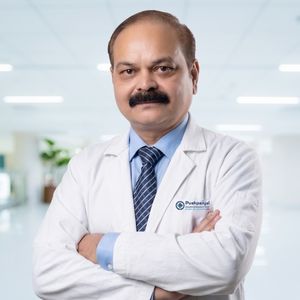
Dr. Vijay Bora, MBBS, MS (Gold Medalist), MCh Urology (IMS-BHU), is a senior urologist in Agra with 28+ years of experience and over 10,000 PCNL procedures. He heads the Department of Urology at Pushpanjali Hospital & Research Centre and is a Past President of the North Zone Urological Society of India. Full profile →
This article is for general education only and is not medical advice. Treatment decisions require clinical examination and investigations. In an emergency, visit the nearest hospital immediately.